
What Made Datadog DASH 2026 Worth Attending
Often when coming home from a conference, I have a notebook (in Goodnotes) full of notes taken from all the talks I attended. This was not that kind of conference for me.
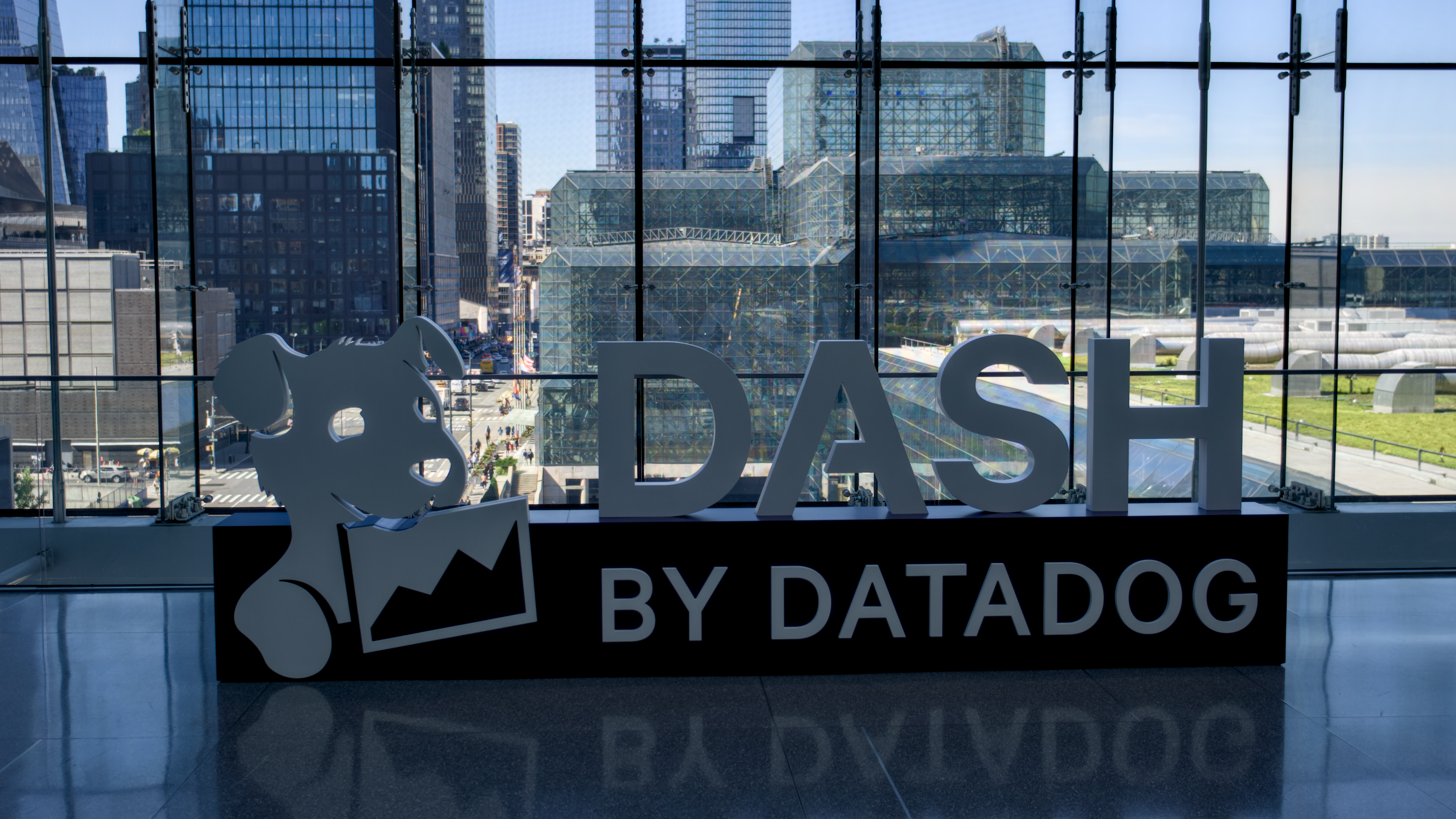
I didn't attend many sessions at Datadog DASH. Not for lack of trying, though. The conference rooms were generally too small for the crowd, so more than once a talk I wanted to attend was full by the time I got to the door. I even ended up sitting on the floor for a couple of talks.
There were sessions I enjoyed, and a few gave me something useful to think about. The trip mattered for two bigger reasons: I got rare in-person time with my teammate João after a year of remote collaboration, and we got direct access to Datadog product leaders while we're deciding how to mature observability, software delivery, and frontend instrumentation at Convergint.
Same Room, Finally
I've been working at Convergint for a little over a year now, and João Almeida joined my team as a Staff Platform Engineer about halfway through that. Coming to DASH was the first time we've been in the same place since we both started working here. 🙃 We worked together at Smartrr as well and visited in New York City then, too. This was a welcome reunion given we work closely together every day and needed some time to unwind together.
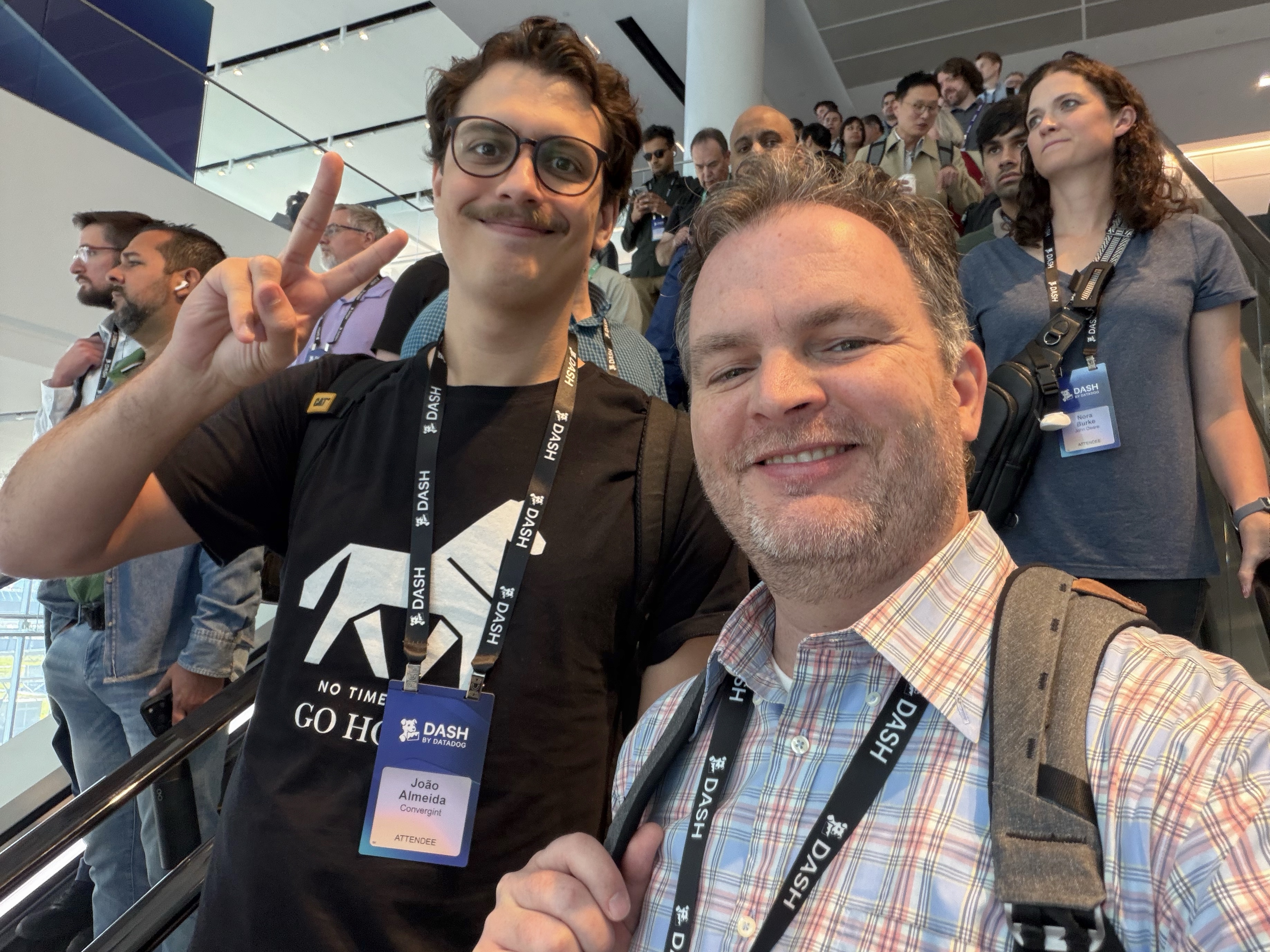
Spending time with our remote teammates is underrated and under-invested in. So many day-to-day micro-frictions can be defused with just a little understanding of our colleagues as actual human beings. Chatting over brunch, riding in an Uber together, or going for a walk to Apple Fifth Avenue all end up shaping our relationships in ways we don't really understand, but when we go back home and are working together through our Slack Huddles or Teams Calls, the difference can be felt. I'm really grateful to have had this time with João and hope we can get our whole team together soon.
The Product Conversations Were the Real Conference
I've had a consistently good experience with Datadog outside the conference. Our account team is both proactive and responsive; when we have questions or product feedback, they're eager to connect us to someone who can talk through the product area with real context, add us to previews in areas where it can help us, or follow up on support tickets when we're having trouble getting a problem solved.
When I arrived at DASH, it was striking to compare that experience with the sheer size of the conference and to realize how special it is that they make me feel so seen and supported yet we are really just a small fish overall. To me this speaks to how customer-forward Datadog is and it explains why their product continues to be so good. And despite there being such a crowd, again, I was booked with several meetings with product managers and engineers across product categories like AI Observability, APM, RUM, Software Delivery, Bits AI and Error Tracking, all thanks to our stellar Account Manager Samantha Levine.
These meetings were opportunities to share some physical space and chat with product leads from these various areas - to share how we're using their products, where we're hitting sharp edges, to ask questions or advice, and hear about upcoming features or capabilities that may help us, given our trajectory.
At Convergint, we're about ~60 software engineers working within an organization of about 10,000 global colleagues. Our work is largely that of supporting internal business processes, but we do have some irons in the fire exploring SaaS software offerings as well. Our use of Datadog thus far has been getting basic logs, metrics, tracing, and log/trace correlation setup for our custom-built applications, beginning to build our comprehensive software catalog and assign ownership to various systems, monitoring code security, and bootstrapping an on-call program powered by Datadog On-Call. Looking forward, we're exploring a broader rollout of Database Monitoring, RUM and other frontend-focused instrumentation (i.e. feature flagging), and taking advantage of more software delivery features like Deployment Gates and Bits Release.
A few of these are worth digging into.
Resilient Software Delivery with Deployment Gates and Bits Release
In my team's Q2/Q3 roadmap we are planning to work with one of the engineering teams to build out first-class support for automated rollbacks upon faulty observability signals. This is a natural evolution of the last few years of work as it builds on the base observability we've helped teams instrument. Deployment Gates encourages teams to dial in what exactly "healthy" means for each of their applications, because if they do, they can use a gate to automatically watch for deviation in these metrics after a deploy and automatically roll back the release if they degrade. This is a pretty big benefit in deploy resilience, allowing devs to ship fast but know the gate has our back! Not to mention, development teams understanding their systems' key metrics and having this kind of observability wired up is a win by itself.
At DASH, João and I had the chance to sit down with Ala Shiban, Group Product Manager at Datadog for Software Delivery. We had a lot to talk about, but my biggest takeaway was that our current adoption trajectory still makes sense in a world where the new Bits Release feature exists, because it builds upon the observability we are incrementally building out. Once we have our Deployment Gates rollout completed, we can then begin looking towards Bits Release as the next step.
Lock-in Free Adoption of the Datadog SDK
Shortly before DASH, Duncan Hewett, Senior Product Manager on the APM team, invited me to try the Datadog SDK's new OpenTelemetry API Support. Vendor lock-in has been the main reason I haven't recommended Datadog SDK adoption for our applications. If teams add Datadog-specific instrumentation throughout their code, it makes future observability vendor changes harder than they should be, creating friction and disincentivizing using the best tool for the job.
OpenTelemetry API Support changes this tradeoff. It allows us to continue instrumenting our application code using vendor-agnostic APIs while still taking advantage of the Datadog SDK's proprietary features, most notably Live Debugging.
While meeting with Ala, he shared how he's most excited about live debugging because it revolutionizes how we debug applications. From his perspective, it removes the need for painstakingly instrumenting specific parts of your app with detailed logs or trace events. Instead, you use live debugging to inspect the application on-the-fly wherever in the code you need it. I think he's right that this is a huge unlock, especially when having agents help us debug, so I'm excited to try out the Datadog SDK's OpenTelemetry API Support and Live Debugging to see if it's as good as it sounds.
Better Baseline Frontend Observability with Real User Monitoring & Feature Flagging
One of the product meetings Samantha set up for us that I wasn't sure would be helpful or not was one with Maël Lilensten, Senior Product Manager for Real User Monitoring (RUM). RUM is purely client-side tooling that is meant to provide observability on user behavior prior to it reaching servers - so like, web pages and mobile applications. Our platform team's skillset skews heavily towards backend, but we're recognizing this and looking for how we can support frontend needs. RUM and feature flagging are obvious areas where every team needs a solution but not every team has them fully solved.
Chatting with Maël, my biggest question was "How can I bridge the gap? If you were me, how would you drive adoption of Datadog RUM?" He had a few good, concrete suggestions:
-
Set up a white-labeled proxy for the RUM endpoint. This prevents client-side ad blockers from blocking the RUM traffic to Datadog, giving better overall coverage. This helps the tooling work the way developers expect.
-
For users using LaunchDarkly today, they can begin seeing the benefits of Datadog Feature Flags immediately by installing the Datadog LaunchDarkly integration. This allows LaunchDarkly events and feature evaluations to show up in Datadog alongside other RUM, Error Tracking, and APM data. Once users start seeing this data, they may decide they prefer Datadog as their feature flag UI, and either migrate existing projects or use Datadog for feature flagging in future projects.
-
For users using PostHog today for feature flagging, they can leverage the RUM Feature Flag Tracking to see those evaluations in Datadog, too.
Overall, he emphasized that the key driver of value for using Datadog over a service specific to feature flagging is the deep integration with other Datadog analytics and the insights you gain by being able to correlate the data.
That made the adoption path clearer for me. We don't need every team to migrate feature flagging or frontend observability at once. We can start by making RUM easier to add, proxying the collection endpoint so ad blockers don't silently reduce coverage, and connecting the feature flag systems teams already use into Datadog where possible.
I also want to investigate OpenFeature for the same reason I use OpenTelemetry on the backend today: keeping vendor-specific integrations at the edges of our applications instead of spreading them through the codebase.
Other Announcements I'd Like to Try
A few other DASH announcements are worth trying as our Datadog usage matures:
-
Bits Database Optimization, where it can leverage an existing Database Monitoring integration plus AI to provide database optimization recommendations that are proven through simulated database testing.
-
Bits Investigation to automate incident response. So far my experience of trying to use this has been less than stellar, but it's hard to blame the tool, it's likely our observability isn't mature enough yet. I'm still going to keep trying this when applicable.
-
AI Agents Console for understanding where AI tools are helping our engineers and where we may need clearer guidance, better enablement, or different tooling. I've got this hooked up now, and I'm giving it some time to collect data. Since this is such a new feature, I'll likely try to give a lot of feedback to the team at Datadog to help improve it, because this is something I'd love to see working well.
What I'm taking back to Convergint
I enjoyed DASH most as time with João and as face time with my Datadog account team and product leaders. Both were worth the trip.
My biggest takeaway is that the advanced Datadog features still depend on the fundamentals. Deployment Gates, Bits Release, Live Debugging, and AI Agents Console are unlocked, and Datadog overall gets more useful when the basics are in place: service ownership, logs, metrics, traces, frontend telemetry, and clean deployment data.
Now that I'm home, I want to keep pushing three things:
-
Finish the groundwork to enable the use of Deployment Gates, and use it to help teams define what healthy means for their applications.
-
Lower the barrier to RUM and Feature Flags so frontend teams can get better production feedback without having to stitch things together from scratch.
-
Make more in-person time possible for our remote team. The value is hard to quantify, but it really improves everyday collaboration.
I'm grateful to Convergint for sending me to the conference and investing in excellent tooling for us engineers to do our best work. ✌️